


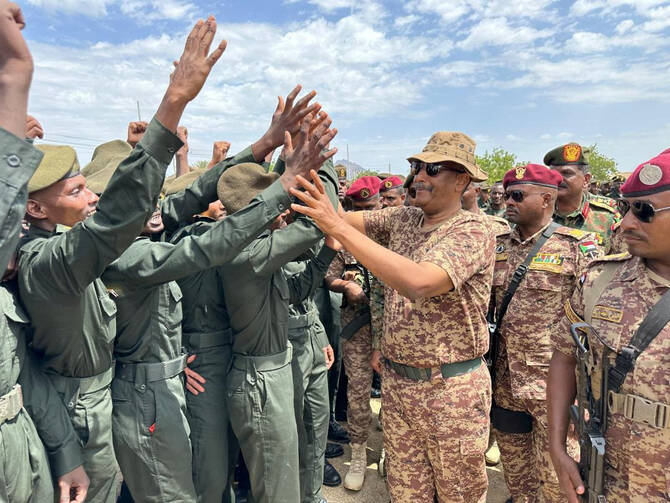
LONDON: More than three years after Sudan descended into civil war, army chief Gen. Abdel Fattah Al-Burhan is pushing for a broad national dialogue aimed at rebuilding the country’s political institutions and laying the foundations for a civilian transition.
Talks could begin as early as August, with preparatory consultations already involving political groups, technocrats, Sufi leaders, traditional authorities, academics, professionals, civil society representatives and independent figures.
The proposed dialogue is expected to focus on three broad issues: ending the war, determining the future structure of the Sudanese state and agreeing arrangements for a transitional period.
For Al-Burhan and the Sudanese Armed Forces, the initiative represents an attempt to move the country from battlefield confrontation toward a political process centered on recognized state institutions.


It comes after the army regained Khartoum and significant areas of central Sudan, shifting the military balance after years of fighting with the paramilitary Rapid Support Forces.
The challenge now is whether those gains can be translated into a political framework broad enough to reunify the country and restore civilian government.
Al-Burhan first announced plans for a comprehensive domestic dialogue in May, saying Sudanese themselves should determine the principles of reconstruction, governance and the country’s eventual civilian democratic transition.
The initiative reflects a position repeatedly advanced by the army leadership: that Sudan’s political future should be determined through national institutions rather than by armed groups establishing parallel structures.
The RSF and its Sudan Founding Alliance, known as Tasis, are therefore not expected to participate in the dialogue.


Al-Burhan has also excluded the National Congress Party of former President Omar Al-Bashir, indicating that the proposed political framework is intended neither to restore the former regime nor recognize the RSF-backed administration.
The distinction is central to the SAF’s approach. Political parties, civil society groups and civilian opposition movements are being invited back into the political process, while organizations that maintain separate armed structures or rival administrations are being treated as a security rather than political issue.
Sudan’s war began in April 2023 following a power struggle between the SAF and RSF, including disagreements over integrating the paramilitary force into a unified national army during the country’s stalled transition to civilian rule.
The conflict devastated Khartoum, displaced millions and spread into multiple regions.


Since retaking the capital and other areas, the army has sought to restore government institutions and present the SAF-controlled state as the basis upon which a national political settlement can be constructed.
The planned dialogue appears deliberately broader than a meeting of Sudan’s traditional political parties.
Civil society groups, resistance committees, tribal leaders, Sufi figures, academics, professionals, technocrats and independent personalities are among those expected to participate or be approached.
That could help revive a civilian political arena badly fragmented by the war.
Resistance committees and professional organizations were central to the uprising that removed Bashir in 2019, while traditional and community leaders retain influence in areas where formal political parties have limited reach.
Bringing those constituencies into a common process would allow discussions over Sudan’s future to extend beyond the military contest between the SAF and RSF.

The SAF leadership also appears conscious that opposition groups will require assurances before joining.
Measures under discussion reportedly include reviewing criminal cases and administrative actions affecting political figures and reducing hostile media campaigns against civilian opponents.
There has also been discussion of establishing an independent preparatory committee responsible for determining participants, the agenda, venue and timing of the talks.
Such a mechanism could prove important in convincing skeptical civilian movements that the dialogue is intended to produce a negotiated framework rather than simply endorse arrangements determined by the military.
It could also provide a structured forum for disagreements over the length of the transition, the composition of governing institutions and the army’s future constitutional role.
The dialogue is expected to examine the future structure of Sudan itself.
Decades of conflict have exposed deep grievances over the concentration of political and economic authority in Khartoum and the marginalization of regions such as Darfur and Kordofan.

The talks could therefore address federalism, regional representation, constitutional arrangements and the distribution of resources and political authority.
These questions will be crucial if the army’s territorial gains are to produce more than simply a restoration of the prewar state.
A durable settlement will require institutions capable of convincing communities outside the center that they have a meaningful stake in national government.
Al-Burhan’s decision to include tribal authorities, community representatives and civilian figures from outside traditional political parties could help bring those concerns directly into the dialogue.
l-Burhan has repeatedly said civilian democratic government remains the intended destination.
For that commitment to gain credibility, however, the dialogue will need to produce clear answers over how authority is transferred and how long the transition will last.
Participants will have to address the formation of transitional institutions, the powers of a future civilian government, the role of the military during the interim period and a roadmap toward elections.
The army will also face pressure to define the point at which its wartime political responsibilities end.
This is where broad civilian participation becomes particularly important.

A transition shaped by a genuinely diverse coalition of civilian parties, professionals, resistance committees and regional representatives would be harder to characterize simply as an extension of military rule.
For the SAF, the national dialogue thus presents both an opportunity and a test.
The army has recovered the capital and restored government authority across significant parts of the country.
But military control alone cannot reunify Sudan or resolve the grievances that contributed to repeated cycles of conflict.
If Al-Burhan can bring together civilian opposition groups, resistance committees, professionals, community leaders and regional representatives around a credible transition, the dialogue could begin moving Sudan away from rule by armed factions and toward functioning national institutions.

